[Economist Wonju = Reporter Kim Du-yong]
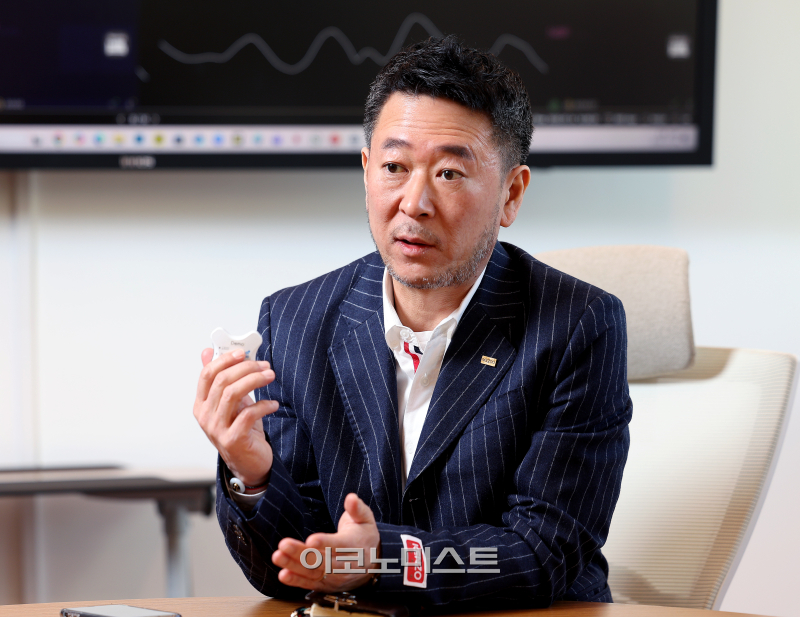
The expression "hitting one's head against the bare ground" (starting from scratch) fits no one better. Park Jung-hwan, CEO of Mezoo, began as an engineering student and went on to earn a PhD in Biomedical Engineering. While he dug a single well deeply as a specialist, he was a mere amateur when he took his first steps as an entrepreneur rather than a technician. Yet, based in Wonju, Gangwon Province—a barren land for startups—he ultimately achieved a KOSDAQ listing. By presenting a "success model" for balanced regional development, he has earned the title of a true "pro." From nurturing local talent to his global healthcare ambitions, Mezoo’s blueprint is as firm as the stubborn beard that has become Park’s trademark.
The Turning Point: A "Second Founding" and the Airbnb Model
Digital healthcare company Mezoo, a startup headquartered in Wonju, has created a rare success story by "passing through the eye of a needle." It shattered the startup myth that "investors don't even look at anything south of Pangyo (near Seoul)" and wrote a new chapter of history by listing on the KOSDAQ from Wonju. Mezoo is set to be listed on the KOSDAQ market on March 26.
It took a full 20 years from its establishment in 2007 for Mezoo to go public. Through numerous crises and pivots (business model shifts), it has secured a foothold for growth in the global digital healthcare market.
In particular, the "Second Founding" in 2018 served as a major turning point. Originally founded in 2007 by five PhDs from the Biomedical Engineering department at Yonsei University’s Wonju Campus, Mezoo started as a typical "service-provider" (outsourcing) firm. It provided medical device solution technologies to established companies.
"2007 was the early days of healthcare. At that time, there were many areas that needed medical or healthcare solutions, but no companies were operating in that business," CEO Park explained. "We founded Mezoo—which stands for 'Medical Equipment Zoo'—with the idea of providing various medical solutions to listed companies, and we supplied solutions to firms like Samsung, LG, and Hyundai Motor."
As a result, the work consisted of constantly breaking through and overcoming technical barriers according to the competitive bidding of the "prime contractors." He mentioned the limitations he felt at the time: "For nearly 10 years, I worked on upgrading technology to meet bidding specifications, but it always felt like running on a treadmill. It was a structure where Mezoo didn't own the main items themselves."
This "normalization of outsourcing" became the starting point for the "Second Founding." "We concluded that since we had the technology, it would be better to do it ourselves," Park said, explaining the background. "In 2018, we cut off all external networking, established a new corporation, and developed our own device solutions."
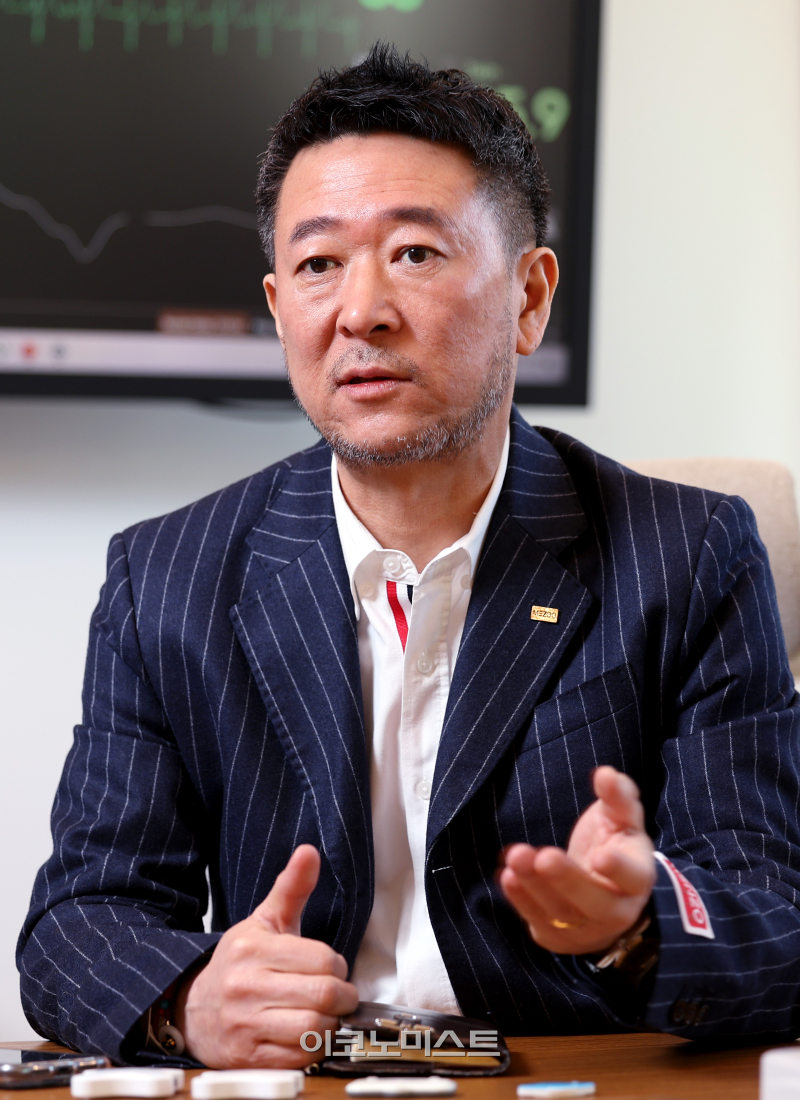
He boldlyd a "Second Founding," but the business side was an entirely different beast. Starting from scratch as an entrepreneur to attract investment, he faced a barrage of difficulties. Attracting capital in the barren environment of Gangwon Province was a particularly daunting hurdle. "I didn't have trouble with the technical side, like designing medical devices. But to commercialize them, I needed initial capital, and there wasn't a single venture capital (VC) firm in Wonju," Park confessed.
Lacking a network, his daily life consisted of running around blindly and facing constant rejection. It was then that he decided on the "Airbnb model." He explained, "I didn't major in business, and I didn't know how to handle capital demands, so I spent every day traveling back and forth to Kyobo Book Centre in Seoul, reading business administration books cover-to-cover. Through knowledge gained from books and meetings with investors, I gradually came to understand the capital market."
He continued, "The 'reference model' I chose while reading those books was Airbnb. When the Airbnb founders first established their corporation, they started with about 200 million KRW (approx. $150k). Their initial seed investment was around 2 billion KRW, for which they gave up over 20% of their equity. Following this reference model, Mezoo's enterprise value at the time was around 6 billion KRW, so I gave up 20% equity and secured 1 billion KRW in investment." This was how the story of Mezoo's equity structure and its early fundraising began.
Since then, Mezoo has secured strong allies, including a 3 billion KRW investment from strategic investor Dong-A ST.
Source : https://economist.co.kr/article/view/ecn202603160060